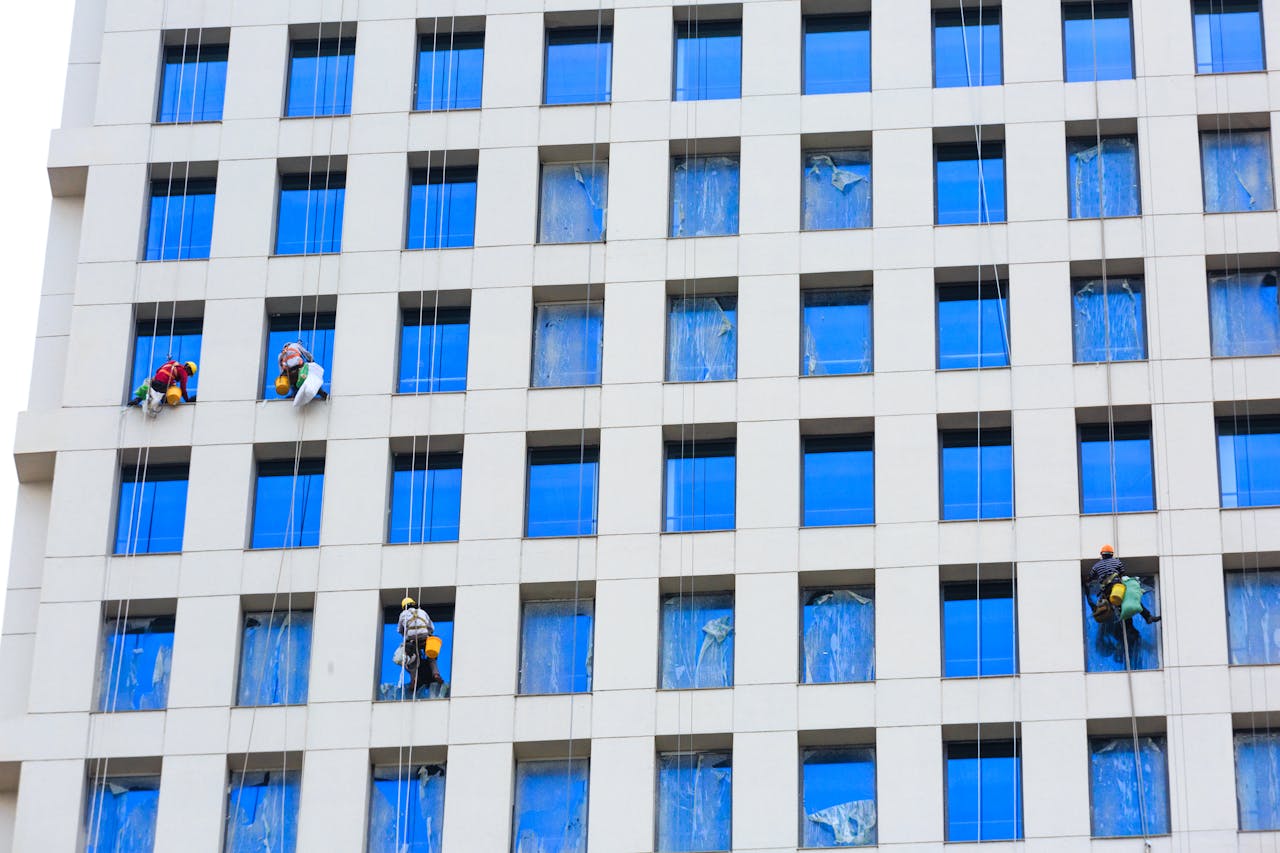
India has some of the most polluted cities in the world. Delhi consistently appears among the top five cities globally for air pollution. Noida, Gurgaon, Faridabad, and other NCR cities share this burden. For the people who live and work there, the health implications are well documented.
What is less talked about is what that same pollution does to buildings. Every day, the same particulate matter, vehicle exhaust, and industrial emissions that affect human health are also landing on building facades — and slowly, steadily degrading them.
This post explains exactly how that happens, which buildings are most vulnerable, and what it means for anyone responsible for maintaining commercial property in an Indian city.
The Pollution Reality in NCR Cities
To understand the impact on buildings, it helps to first understand the scale of the problem. NCR cities — particularly Delhi, Noida, Gurgaon, Faridabad, and Ghaziabad — experience some of the worst air quality in Asia.
Delhi
Average AQI in peak winter months. "Hazardous" range. Heavy vehicular + industrial load.
Noida
High construction activity + industrial zones + expressway traffic combine for severe pollution.
Gurgaon
Dense commercial zones, heavy vehicle traffic, and proximity to Haryana industrial areas.
These AQI numbers tell you what the air is like to breathe. For buildings, the relevant measure is the rate of pollutant deposition on surfaces — which is broadly proportional to ambient pollution levels. High pollution = faster deposition = faster facade degradation.
What Is Actually Landing on Building Facades
Air pollution is not a single thing. The pollutants that affect building facades include several distinct types, each causing different kinds of damage:
Particulate Matter (PM2.5 & PM10)
Fine dust and soot particles that stick to facade surfaces, penetrate pores, and create a persistent dark film. PM2.5 is so fine it embeds deeply into stone and concrete textures.
Sulphur Dioxide (SO₂)
Reacts with moisture to form sulphuric acid. Attacks calcium-based materials — limestone, marble, sandstone, concrete — converting them into softer, more soluble gypsum.
Nitrogen Oxides (NOₓ)
Combine with moisture to form nitric acid. Similar corrosive effect to SO₂ on stone and concrete. Also contributes to the dark discolouration on building surfaces.
Carbon Particles (Black Carbon)
The black soot component of vehicle exhaust. Highly adhesive — bonds strongly to glass, metal, and painted surfaces. The main reason buildings in high-traffic areas turn visibly black.
Construction & Silica Dust
Particularly severe in Noida and Greater Noida due to ongoing development. Silica particles scratch glass and embed in surface textures, accelerating weathering.
Heavy Metal Particles
Lead, cadmium, zinc from industrial emissions and crop burning. These create chemical staining on stone and metal surfaces that is difficult to remove once bonded.
How Pollution Damages Different Facade Materials
Glass Facades
Glass looks hard and impervious, but it is more vulnerable to pollution than most people realise. The primary mechanism is chemical etching — a gradual process where acidic pollutants dissolved in rainwater react with the glass surface at a microscopic level.
In practical terms, here is what you see happening to glass facades in NCR cities:
- Hazing — glass progressively loses its transparency as a thin film of silica, calcium sulphate, and carbon deposits builds up
- Streaking — black carbon and dust run down the glass in rain, leaving dark vertical marks
- Permanent etching — if the deposit-and-react cycle continues for years without cleaning, chemical etching becomes irreversible. The glass surface itself is damaged, not just dirty
Glass facades on buildings near Noida Expressway or Delhi's main arterial roads often show advanced hazing within 12-18 months of last cleaning if pollution levels are high.
ACP (Aluminium Composite Panel) Cladding
ACP panels are everywhere in NCR's commercial buildings. They are popular because they are lightweight, versatile, and relatively low-maintenance. But pollution takes a toll on them over time in two main ways:
- Coating degradation — the polyester or PVDF coating on ACP panels protects the aluminium underneath. Acidic pollutants attack this coating, causing it to chalk (form a white powder on the surface) and eventually fail. Once the coating fails, the bare aluminium is exposed and corrosion begins.
- Deep staining — carbon particles and industrial emissions create staining that penetrates the coating surface. After a certain point, this cannot be fully cleaned without removing the coating itself.
Concrete and Painted Surfaces
Concrete is porous. This makes it excellent at building up over time — but it also means pollutants penetrate below the surface. The sulphation process (SO₂ + moisture + calcium = gypsum) actively converts the surface layer of concrete and cement from a hard, dense material to a soft, powdery one. Paint on concrete traps this reaction beneath it, leading to blistering and peeling.
In Noida's developing zones, where buildings are surrounded by construction activity for years, concrete facades accumulate silica dust and construction chemicals in addition to air pollution. The combination ages concrete surfaces faster than in more established areas.
Natural Stone — Marble, Granite, Limestone
Heritage buildings and premium residential projects across India use natural stone facades. These are the most vulnerable to pollution damage in the long run.
Marble and limestone are calcium carbonate — the exact material that sulphuric and nitric acids attack. Buildings in polluted Indian cities that have marble or limestone facades can show measurable surface loss over years of pollution exposure. This is not a hypothetical concern. Historic buildings across Delhi have visible surface deterioration directly attributable to acid rain and pollution deposition.
Irreversible Damage Threshold
For stone facades especially, there is a threshold beyond which damage cannot be reversed — only concealed or replaced. Regular cleaning removes pollutants before they react with the stone surface. Once sulphation has occurred, the converted material (gypsum) must be carefully removed, but the loss of original surface is permanent. Prevention is the only truly effective strategy.
The Seasonal Pattern in NCR Cities
Pollution damage to facades in NCR follows a distinct seasonal pattern that building managers should be aware of:
Winter (October – February): Highest Risk Period
This is when pollution peaks. Temperature inversions trap pollutants close to the ground. Crop stubble burning in Punjab and Haryana adds heavy particulate load. Vehicle exhaust and industrial emissions are less dispersed due to low wind speeds. Facades in NCR cities accumulate the most pollution during these months. Buildings with north-facing facades (that get less sun and wind) can develop visible black carbon deposits in weeks.
Monsoon (July – September): Chemical Reaction Season
The monsoon brings rain, which washes away some surface deposits. But it also activates the chemical damage mechanisms. Rain dissolves SO₂ and NOₓ from accumulated pollution deposits, creating acidic runoff that flows across facade surfaces. This is when sulphation and etching progress most rapidly. The iconic "black streaks" that appear on buildings after monsoon rains are pollution-laden water channels leaving visible marks.
Summer (March – June): Dust and UV Season
Dry season dust storms — common in NCR from March to May — deposit large quantities of silica-rich dust on facades. The abrasive nature of this dust, combined with UV exposure at high levels, degrades surface coatings and accelerates weathering. Glass facades are particularly affected — dust acts as a mild abrasive under strong winds.
What This Means for Your Cleaning Schedule
Understanding the seasonal pollution pattern suggests the optimal cleaning schedule for NCR buildings:
- October-November — clean before the worst winter pollution arrives. Start the peak season with a clean facade that has less accumulated load to react with.
- February-March — clean after the peak winter pollution period ends. Remove the heavy deposits before the monsoon activates the acid reaction cycle.
- High-pollution buildings (near expressways, construction zones, industrial areas) — add a third cleaning in July-August if the budget allows.
This is exactly why we recommend twice-yearly cleaning for most commercial buildings in NCR — once before peak pollution season and once after. It is aligned with the actual pollution cycle, not just an arbitrary schedule.
The Compounding Effect: Why Waiting Makes It Worse
One important point about pollution damage is that it is not linear — it compounds. A facade with two years of pollution accumulation is not just twice as dirty as one with one year of accumulation. The older layer of deposits provides a substrate that new deposits bond to more strongly. The chemistry that damages materials accelerates as the reaction products accumulate. Biological growth — which follows pollution deposition — creates its own additional damage mechanisms.
This is one of the key reasons why regular, scheduled cleaning is more cost-effective than cleaning on an emergency or cosmetic basis. The longer you wait, the harder and more expensive the cleaning job becomes. And beyond a certain point, cleaning cannot fully reverse the damage — only slow it down.
For a detailed explanation of the structural damage mechanisms, read our post on how facade cleaning extends building lifespan.
What You Can Do
The reality of pollution levels in NCR cities is not something building owners can control. What you can control is how effectively you protect your building from its effects.
- Establish a regular cleaning schedule — twice yearly minimum for most commercial buildings in NCR
- Use material-appropriate methods — the wrong cleaning method can accelerate damage rather than prevent it
- Consider protective coatings — certain anti-pollution or hydrophobic coatings applied after cleaning can slow re-deposition rates
- Monitor facade condition — regular professional assessment catches early-stage damage before it escalates
- Act faster on visible growth — biological growth on facades should be treated promptly; it worsens rapidly in NCR's climate
If you are in Noida, Delhi, or Gurgaon and would like a professional assessment of your building's facade condition, get in touch with us. We have been working with NCR buildings for over 15 years and understand the specific pollution challenges in each area. We will give you an honest assessment and a practical plan — not an oversized quote for work your building does not need.